
Magnifying glasses, books and activity guides are just a few of the things you’ll see when you walk up to a Citizen’s Science Corner. These displays are dedicated spaces housed in public libraries that feature books on local flora and fauna, interactive kits, and step-by-step guides that facilitate contribution to real, ongoing research projects.
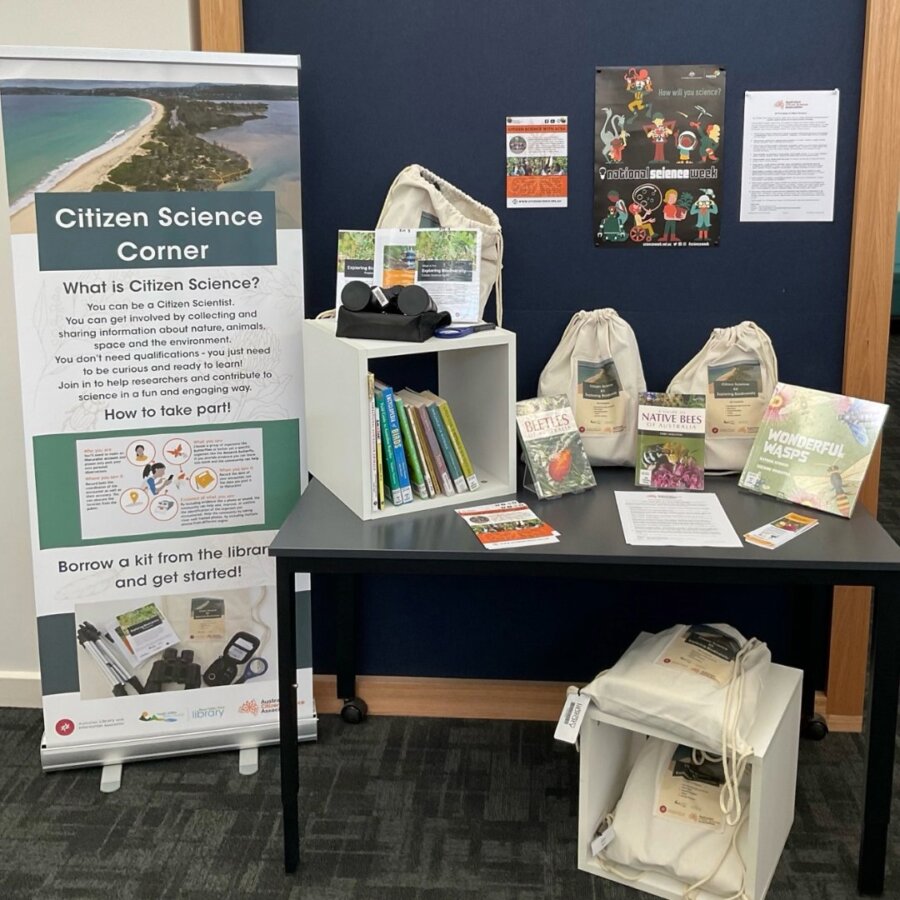
These growing displays are a collaborative effort between the Australian Library and Information Association (ALIA) and the Australian Citizen Science Association (ACSA). The idea was developed by Dr Bridie Schultz, Vice Chair of the ACSA and co-founder of teachSTEM Ltd, in partnership with Dr Helen Weston, education researcher and librarian. Schultz generously shared her insights via written correspondence, which informed much of this article.
How do Citizen Science Corners contribute to research and why do they matter?
Citizen Science Corners are not just displays, they are entry points into real scientific research. Libraries can choose from an array of different project types, selecting what makes the most sense for their local ecology and community interests.

The project entitled Mapping Mosquito Habitats, for example, allows participants to identify habitats and document mosquitoes in their community. Each kit includes a magnification tool, a container, syringe, tray, and measuring tape. Participants photograph habitats and capture up close images of larvae, then upload their data to the Globe Observer app.
When participants upload their findings, that data does not simply sit idle. It becomes part of national and global biodiversity datasets used by researchers to track species distribution, environmental changes, and more. In the case of Mapping Mosquito Habitats, the data contributes to research on mosquito populations, providing an additional resource for scientists to track the world's deadliest animal. However if mosquitoes aren’t your thing, there are many other projects to explore suited to a variety of interests!
Why libraries?
“Libraries are one of the few spaces left where anyone can walk in for free and feel genuinely welcome,” Schultz explains, “and citizen science is built on the same principle of open participation.”
Traditionally, contributing to science required a degree, extensive equipment, and formal training. Now all you need is a library card and the readiness to learn. Citizen Science Corners eliminate those barriers and allow for the informal building of scientific literacy across a wide range of age groups. Libraries also have strong, established connections to their local communities which means that their selected projects can generate data that is directly relevant to where they live. For students, the kits focus on project-based and exploratory learning rather than assessment and curriculum requirements adds to what students learn in the classroom in a way that is low-pressure, hands-on and accessible. In many ways, libraries and citizen science share the same foundations: learning, accessibility, and discovery – making the partnership a natural fit.
The idea itself began in 2022 at the National Education Summit in Brisbane during a conversation between Dr Schultz and Dr Weston. Weston wanted to meaningfully integrate science into her inner city school library, and after brainstorming together they piloted the first Citizen Science Corner at Loreto College. Working off the students' interests, Schultz found existing projects that could easily integrate into the school library and complement classroom learning. The program proved highly successful.
With the support of the Maker Projects for Community STEM Engagement grant, the collaboration between the ALIA and the ACSA began and expanded the model into public libraries across Australia. The project funded 98 libraries, however, the interest was so high that an additional 30 opted to participate without funding. Citizen science corners have even been established internationally, with locations in three schools in Kenya and one in the Philippines.
At the community level, librarians have shared that not only has this been a valuable resource for school students, but also families, older adults and homeschooling groups. This vast participation often begins with curiosity and then evolves into something more meaningful. As Schultz reflects, “When someone uploads their first observation or attends a workshop, they often shift from seeing science as something done by experts elsewhere to recognising that they can play a meaningful role in generating knowledge”.
Looking ahead, Schultz would like to see Citizen Science Corners become an embedded feature of libraries. Expansion discussions are underway with councils in Queensland and New South Wales, along with efforts to connect Australian libraries to global citizen science campaigns. Strengthening the link between community collected data and local council decision making is another long-term goal, ensuring that locally gathered observations can inform environmental planning and policy.
Citizen science in libraries represents an important step towards increasing access to hands-on learning opportunities for all ages, while simultaneously strengthening the data available to researchers. By opening the door for the public to participate directly in scientific research, Citizen Science Corners benefit both our communities and our collective understanding of the environment.
Don’t have a library near you with a citizen science corner quite yet? Here are some other ways to participate in Citizen Science:
Planting Seeds will be hosting a citizen science workshop at the Randwick Sustainability Hub from 10 - 11:30am on Saturday the 14th of March. If interested, sign up for your free ticket at this link.
ACSA Projects Finder was developed in partnership with the Atlas of Living Australia, this finder allows you to filter for citizen projects in your local area that you can participate in today.
Log your local flora and fauna on the INaturalist app. The app combines your photographs, location data, and species identifications to create verified records that are added to a global biodiversity database.
Article By Alaina Parr
Image 1 retrieved from https://www.teachstem.com.au/citizen-science-corner-program/
Image 2 retrieved from https://scistarter.org/citizen-science-kit-mapping-mosquito-habitats
Additional Sources:
The SciStarter Foundation . (2023, April). Citizen science kit - mapping Mosquito Habitats. SciStarter. https://scistarter.org/citizen-science-kit-mapping-mosquito-habitats
Schultz, B., Weston, H., & Lucas, J. (2025). Nurturing Young Environmental Stewards: A Citizen Science Corner in an Australian School Library. In P. Hauke, A. Mocatta, & P. Nga Ian Pun (Eds.), Libraries Driving Education for Sustainable Development. Berlin: De Gruyter Saur. https://doi.org/10.1515/9783111336466-007