
“The sky is connected to Country – the moon, the tides. The first problem was separation. If you separate the plants from the animals, both disappear.”—Peter Cooley
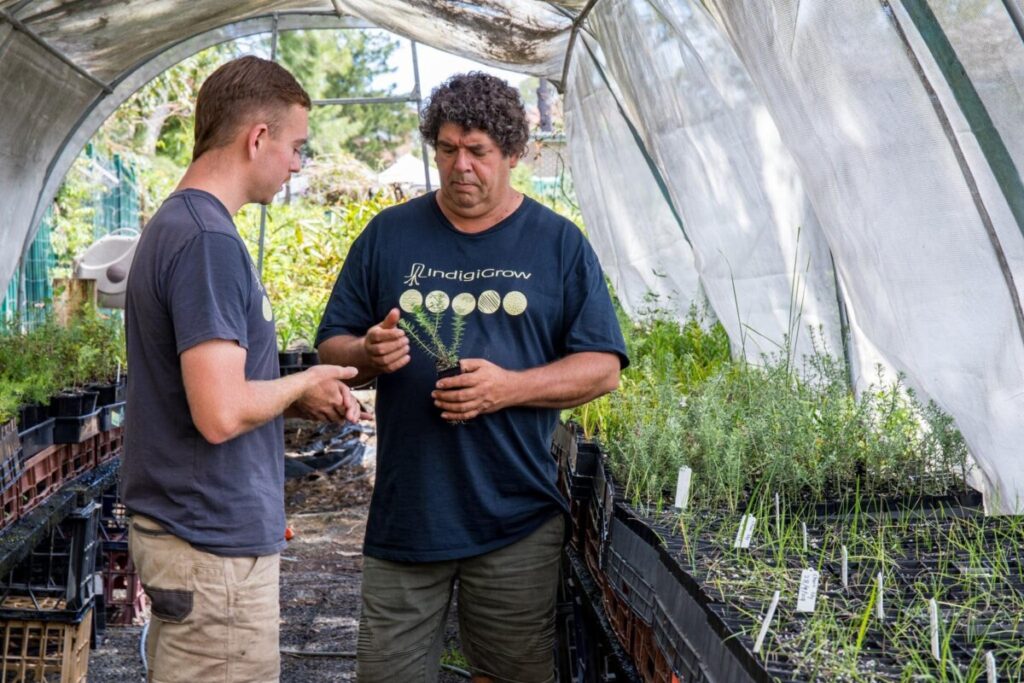
Image supplied by Peter Cooley and (C) Indigigrow
Peter Cooley, a proud Bidjigal man from Sydney’s La Perouse, is the co-founder and CEO of First Hand Solutions Aboriginal Corporation (FHS). Growing up, Peter was fortunate to learn from Elders about looking after Country, but today he sees how much of that cultural knowledge is no longer being passed down. His vision through FHS is to strengthen and empower Aboriginal people and communities by creating training, employment, and economic opportunities grounded in culture.
One of three social enterprises under the FHS umbrella is IndigiGrow, a 100% Aboriginal-owned not-for-profit native plant nursery providing education programs, and the propagation and wholesale of local endangered native plants and bush foods. With two nurseries in La Perouse and Matraville, IndigiGrow blends traditional knowledge with horticultural science. Peter’s aim is to care for critically endangered ecosystems, such as the Eastern Suburbs Banksia Scrub (ESBS), while reconnecting young Aboriginal people with land and cultural knowledge through horticulture.
Planting Seeds has been working with IndigiGrow since 2020, sourcing plants and native flora knowledge to share with students in schools across Australia. Recently, I had the opportunity to yarn with Peter at IndigiGrow in La Perouse and asked him a few questions.
WG: I just read an article by Randwick City Council about the Critically Endangered Eastern Suburbs Banksia Scrub (ESBS). It mentioned that many native plants in the ESBS cannot be reproduced in nurseries, and that once gone, they are gone forever. Can you speak a little about this?
PC: I’d say they are referring to the very difficult to propagate ESBS species of which there are many. One problem lies with the horticultural industry not willing to invest the time, resources and money into growing these difficult species. We only have 3% of ESBS remaining on our coastline which leaves very minimal seed and plant material available to propagate from. Another real problem is the large-scale production and sale of non-native plant species by a huge number of plant nurseries and retail outlets. Non-native plants play a massive role in the destruction of local biodiversity—their seeds easily escape residential gardens by wind, water, and wildlife and find their way into our native areas and quickly take over. The loss of our local species equals the loss of our wildlife. Local native plants have a unique relationship with animals that can’t be separated.
WG: As a social work student, I’ve been reflecting on what it means to walk gently on Country, with reverence. This relates to the concept of ‘leaving no trace’. Can you share your thoughts about this idea?
PC: I think for me this is about the on-going removal and destruction of our native habitat. Even though we only have 3% of our local plants remaining on our coast, we still see more removed for development. We need to be doing what we can to look after our environment and that means developing and implementing long term sustainable measures to ensure we don’t end up with a coastline that has no remnant bushland remaining. Everything we do must be sustainable. When we go onto Country to collect the plants for propagation, we make sure we’re not harming the plant. We only take seed when there is enough for regeneration. We approach the plant with good energy and intentions; plants can feel energy. We wait for the right time: first flowering, then fruit, then new growth. Only after the plant has been through its reproductive cycle do we then take cuttings. The Aboriginal ways are about respect—taking only what you need and doing it in the right way. By taking after it has flowered and produced its seed, we ensure wildlife get their share and enough also drops to the ground to create the seedbank which germinates when the right conditions come along.
WG: When planting what should we be mindful of?
PC: Many planting or greening projects are designed for humans—prioritising shade, appearance, or quick growth. But when planting for Country, we also need to include the understorey, which are the shrubs and groundcovers that support biodiversity. Up to 70% of biodiversity sits in the understory of our plant communities, so we also need to consider this when creating regenerative projects that are designed to support and increase biodiversity. This is especially vital in built-up areas where it’s often missing. And in my opinion, the plants need to be endemic to the area and not just native to Australia. It’s about shifting the mindset. We’re used to designing landscapes for looks and convenience but planting for Country means thinking about what the land and animals need. We need to bring back the species that have always been part of this place.
WG: What else can we do?
PC: In my opinion, we need to provide more education programs in early learning centres, schools, and the wider community about the importance of our native biodiversity. Local Councils should also be encouraging residents to plant local native plant species where possible. We can make huge environmental impacts if we are all on the same page and working together. We can restore habitat, increase biodiversity and revive threatened species if we all understand our environment and support good initiatives in the community that work.
Peter also spoke about his success at propagating Styphelia viridis, commonly known as Five Corners, Fivies, or bush lollies. This native bushfood holds deep cultural and ecological significance—for many Aboriginal people, the sweet berries are remembered fondly as “bush lollies”. While the seeds are extremely difficult to germinate, Peter and his team have found success using a blend of cultural knowledge and Western methods, thus making IndigiGrow one of the few places to successfully propagate the plant.
Peter kindly showed me around the nursery and greenhouse. I was delighted to spot a large, green, metallic carpenter bee burrowed into a bush dotted with small white flowers—the Hardenbergia violacea, commonly known as White Out. It was the first time I had seen one of these bees, and it felt like a quiet reminder of what biodiversity brings to a garden. I also had the opportunity to taste native raspberries and take home some lemon myrtle leaves to brew into tea.
As I left the IndigiGrow nursery, I kept thinking about the carpenter bee nestled in the native flowers. It was a stark reminder that pollinators—like the people, plants, and knowledge Peter nurtures—play an essential role in keeping Country healthy and connected. Through listening, learning, and planting with purpose, we all have a role to play in protecting Country and helping it thrive.

Photo: Peter Cooley
Profile by Wendy Grenfell